Under-eye fillers

Drs. Tom van Eijk
Under-eye fillers may help soften a hollow tear trough or shadow between the lower eyelid and cheek. They are mainly considered when loss of volume makes the under-eye area appear sunken or tired.
They are usually less suitable when the concern is caused by fluid-related puffiness, prominent fat pads, substantial loose skin or pigmentation. Adding filler does not remove these causes and may sometimes make swelling more noticeable.
The first step is therefore to identify what is causing the concern. During a consultation, a practitioner should assess the tear trough, skin quality, fluid retention, fat pads, cheek volume and surrounding facial structure.
This page explains what under-eye fillers may treat, when another option may be more appropriate, possible risks, recovery, costs and how to compare UK clinics and practitioners.
Use Injectablesbooking.co.uk to compare practitioners and clinics by location, experience, reviews, availability and clinic-managed rates.
Read more about filler treatment.

When can under-eye fillers help?
Under-eye fillers may help when the concern is mainly caused by a hollow or loss of support beneath the eye. They are less likely to help when the main problem is fluid, protruding fat or excess skin.
Hollow tear troughs and volume loss
The tear trough is the groove between the lower eyelid and upper cheek. When this groove becomes deeper, it can create shadowing and make the face appear tired.
A small amount of hyaluronic acid filler may soften this transition in suitable patients.
Under-eye fillers may be considered when there is:
a visible tear trough;
mild or moderate under-eye hollowing;
shadowing caused by volume loss;
reduced cheek or mid-face support;
suitable skin quality without substantial excess skin.
The assessment should include the cheeks and mid-face as well as the area directly beneath the eyes. Loss of support elsewhere in the face can contribute to the appearance of the tear trough.
When under-eye fillers may be less suitable
Under-eye fillers are usually less suitable when the concern is mainly caused by:
fluid-related puffiness;
prominent under-eye fat pads;
substantial loose skin;
marked skin laxity;
pigmentation or visible blood vessels;
temporary swelling linked to allergies or sleep;
an unexplained medical cause.
In these situations, filler may add volume without treating the underlying cause.
Read more about what fillers are?
What type of under-eye concern do you have?
The phrase “under-eye bags” can describe several different concerns. Identifying the main cause is important because each may require a different approach.
Hollow tear trough
A hollow tear trough creates a deeper transition between the lower eyelid and cheek. The resulting shadow is the type of concern that under-eye filler may sometimes improve.
Fluid-related puffiness
Fluid-related bags may change from day to day. Sleep, allergies, lifestyle, natural anatomy and medical factors may contribute.
Filler does not remove fluid. In people who are already prone to swelling, it may make puffiness more noticeable.
Prominent fat pads
Under-eye bags may be caused by fat pads becoming more visible. Filler does not remove these fat pads. A surgical assessment may be more appropriate in some cases.
Loose or excess skin
Under-eye fillers cannot remove excess skin. Where loose skin is the main concern, a skin treatment or assessment for lower eyelid surgery may be more relevant.
Dark circles
Dark circles may be caused by shadowing, pigmentation, thin skin or visible blood vessels.
Filler may help when shadowing from a hollow is the main cause. It will not directly treat pigmentation, thin skin or visible blood vessels.
Read more about dark circles fillers.
What can under-eye fillers treat?
Not every under-eye concern responds in the same way to filler.
Often considered
A clearly hollow tear trough may sometimes be treated with filler. The aim is to soften the transition between the lower eyelid and cheek rather than make the area completely flat.
Sometimes considered
Under-eye filler may be suitable for mild hollowing or shadowing caused by volume loss. Suitability depends on facial anatomy, skin quality and the person’s tendency to retain fluid.
Limited benefit
Filler may provide limited benefit where dark colouring is mainly caused by pigmentation, thin skin or visible blood vessels rather than a structural hollow.
Usually unsuitable
Under-eye fillers are generally less appropriate for:
fluid-related bags;
prominent fat pads;
substantial loose skin;
marked skin laxity;
pigmentation without a visible hollow;
unexplained or persistent swelling.
A conservative approach is particularly important beneath the eyes. Too much product can cause puffiness, irregularities or an overfilled appearance.
How does under-eye filler treatment work?
Treatment should begin with a consultation and assessment. The practitioner considers whether the concern is caused by volume loss, fluid, fat pads, loose skin or discolouration.
The assessment may include:
tear trough depth;
skin quality and elasticity;
tendency to swell;
visible fat pads;
cheek volume;
mid-face support;
previous filler treatments;
medical history;
treatment expectations.
Consultation and suitability
During the consultation, the practitioner should discuss your concerns, medical background and expectations.
A responsible practitioner should also explain when under-eye filler is not appropriate. Fluid-related bags, prominent fat pads and substantial excess skin do not disappear when more volume is added.
Hyaluronic acid filler
Hyaluronic acid filler is commonly used where subtle volume replacement is appropriate. Only a small amount may be needed beneath the eyes.
The practitioner may use a fine needle or cannula. The chosen technique depends on the anatomy, treatment plan, injection depth, product and practitioner’s training.
The skin beneath the eyes is thin, so product placement and quantity must be considered carefully.
Read more about hyaluronic acid filler.
Under-eye filler, skin booster or eyelid surgery?
Different under-eye concerns may require different treatments.
Under-eye filler
Under-eye or tear trough filler may be considered for a hollow, mild volume loss or shadowing. It is usually less suitable for fluid-related bags, prominent fat pads or substantial loose skin.
Skin booster
A skin booster is mainly intended to support hydration and skin quality. It does not usually correct a deep structural hollow or remove fat pads.
Lower eyelid surgery
Lower eyelid surgery, also known as lower blepharoplasty, may be assessed when prominent fat pads or excess skin are the main concern.
Suitability must be determined by an appropriately qualified surgical practitioner.
Skin treatment
Treatments aimed at pigmentation, visible blood vessels or skin quality may be more suitable when colour or texture is the main concern.
Medical assessment
Persistent or unexplained swelling may require assessment of allergies, medication, lifestyle factors or an underlying medical cause before cosmetic treatment is considered.
More than one factor may be present. A personal assessment is therefore more useful than choosing a treatment based only on its name or price.
Under-eye filler before and after photos
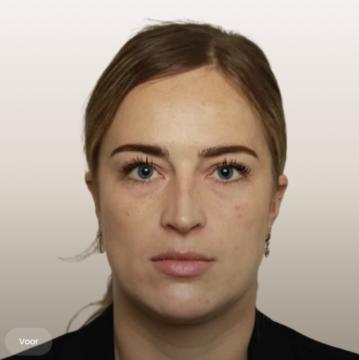
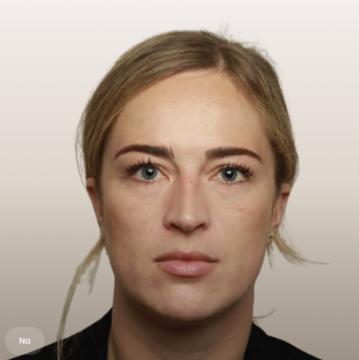
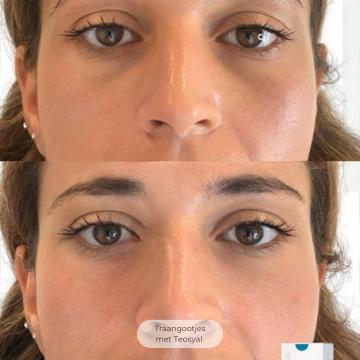
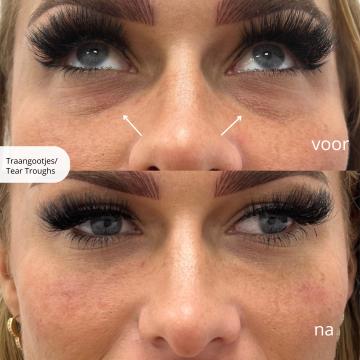
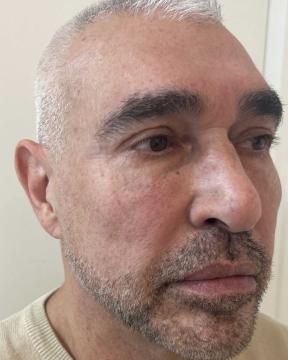
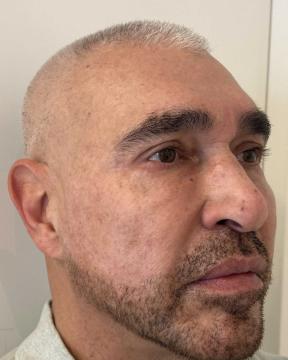
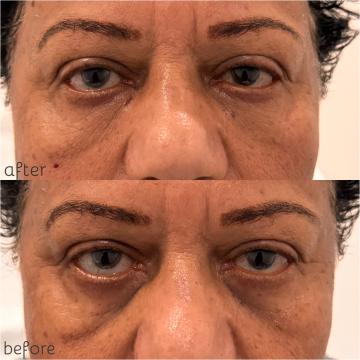
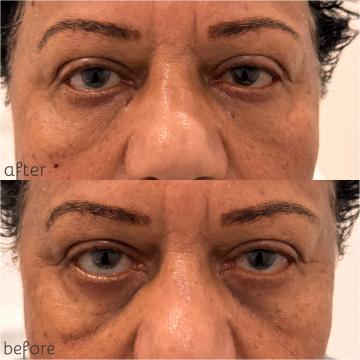


Under-eye filler before and after: what can you expect?
Before-and-after photographs may show a softer transition between the lower eyelid and cheek.
The intended result is usually subtle. The aim is not to remove every natural contour, but to reduce the appearance of a suitable hollow or shadow.
Photographs cannot predict an individual result. Outcomes depend on:
the cause of the concern;
skin quality;
amount of volume loss;
facial anatomy;
filler choice;
treatment technique;
tendency to swell.
When reviewing photographs, look for:
consistent lighting;
similar facial expressions;
comparable camera angles;
patients with a similar under-eye concern;
natural-looking results without obvious overfilling;
clear information about recovery and swelling.
Be cautious of examples that appear heavily edited or use completely different lighting and angles.
Read more about fillers before and after.
Under-eye filler results and duration
An initial difference may be visible soon after treatment, but swelling can affect how the area looks during the first few days.
When can the result be assessed?
The practitioner should explain when the result can be assessed properly and whether a follow-up appointment is included.
Additional filler should not be placed too quickly. Temporary swelling may make the area appear fuller than the final result.
How long do under-eye fillers last?
The duration varies between individuals. It may be influenced by:
the product used;
the amount placed;
metabolism;
facial movement;
skin quality;
treatment technique;
natural facial ageing.
The practitioner should provide a realistic estimate rather than guarantee a fixed duration.
Read more about how long do dermal fillers last?
How much do under-eye fillers cost?
The cost of under-eye fillers varies between UK clinics and practitioners.
The final price may depend on:
the consultation;
the product used;
the quantity required;
practitioner experience;
treatment complexity;
whether cheek support also needs assessment;
follow-up arrangements;
clinic location.
Do not choose an under-eye treatment based only on the lowest advertised price.
Compare the practitioner’s experience with tear trough treatment, how carefully suitability is assessed, reviews, aftercare and the explanation of possible complications.
No exact UK prices have been added because no approved UK pricing was supplied.
Read more about fillers cost.
Risks and side effects of under-eye fillers
The under-eye area is a technically sensitive treatment area. The skin is thin, swelling can be noticeable and the surrounding anatomy requires careful assessment.
Possible side effects and unwanted results include:
temporary swelling;
bruising;
redness;
tenderness;
small injection marks;
lumps or irregularities;
prolonged puffiness;
asymmetry;
overcorrection;
a blue-grey appearance known as the Tyndall effect;
infection;
rare vascular complications.
People who are prone to fluid retention or under-eye oedema may be less suitable for treatment.
Contact the treating clinic promptly if you experience:
increasing pain;
marked skin discolouration;
severe or worsening swelling;
increasing redness;
visual symptoms;
symptoms that do not match the aftercare advice.
Read more about dermal filler side effects.
Can Botox treat under-eye bags?
Botox is not usually the standard treatment for under-eye bags or a hollow tear trough.
The appropriate treatment depends on whether the concern is caused by volume loss, fluid, prominent fat pads, skin laxity, muscle activity or pigmentation.
An assessment should take place before any treatment is recommended.
What if under-eye filler does not look right?
Ask the treating clinic to assess the result if the area looks unusually full, uneven, blue-grey or persistently puffy.
Some swelling may be part of normal recovery, but possible signs of an unwanted result include:
excessive volume;
visible lumps;
prolonged puffiness;
blue-grey discolouration;
asymmetry;
an unnatural transition between the eye and cheek.
Where hyaluronic acid filler has been used, an appropriately qualified medical professional may discuss whether treatment with hyaluronidase is suitable.
This requires an individual assessment and should not be treated as an automatic correction.
Read more about dermal filler lumps.
Recovery and aftercare after under-eye fillers
Temporary swelling, redness, tenderness or bruising may occur after treatment.
Follow the personalised instructions provided by the treating practitioner. General advice may include:
do not rub or massage the area unless instructed;
avoid strenuous exercise for the period advised;
temporarily avoid saunas, sunbeds and excessive heat;
avoid applying make-up until the injection points have closed;
use cooling only if recommended;
avoid direct pressure on the treated area;
contact the clinic if symptoms become worse or unexpected.
Recovery advice may differ depending on the technique used, your medical history and how the area responds.
Swelling or bruising does not automatically mean the result has gone wrong. However, symptoms that become worse or do not match the expected recovery should be assessed.
How to compare under-eye filler practitioners
- 1 Check their professional background and relevant UK registration where applicable.
- 2 Look for specific experience with tear trough and under-eye filler treatments.
- 3 Ask how they identify the cause of your under-eye concern.
- 4 Review realistic before-and-after photographs and independent reviews.
- 5 Ask about risks, aftercare, emergency support and correction options.
- 6 Compare experience and assessment standards, not only price.
How do you choose an under-eye filler practitioner?
Choose a practitioner with specific training and experience in assessing and treating the under-eye area.
Where someone describes themselves as a doctor, dentist, nurse, pharmacist or another regulated healthcare professional, check their registration with the relevant UK regulator.
Also consider:
experience with tear trough filler;
understanding of under-eye anatomy;
a conservative treatment approach;
appropriate insurance;
access to suitable emergency procedures;
clear information about risks and aftercare;
realistic expectations;
transparent rates;
relevant reviews;
unedited before-and-after examples where available.
A careful practitioner should also explain when filler is not suitable. Recommending no treatment or a different assessment can be a sign of responsible practice.
Read more about how to choose a dermal filler practitioner.
Compare clinics for under-eye fillers
Compare UK clinics and practitioners by location, relevant experience, reviews, availability and clinic-managed rates.
Arrange a consultation before deciding on treatment. The practitioner should assess whether the concern is mainly caused by:
a hollow tear trough;
loss of cheek support;
fluid retention;
prominent fat pads;
excess skin;
pigmentation or visible blood vessels.
This reduces the risk of using filler for a concern that may be better managed with another treatment or medical assessment.
Compare clinics in United Kingdom

- Tear trough / bags under eyes from
- £ 400,00



- Tear trough / bags under eyes from
- £ 500,00


- Tear trough / bags under eyes from
- £ 400,00

- Tear trough / bags under eyes from
- £ 400,00

- Tear trough / bags under eyes from
- £ 400,00

- Tear trough / bags under eyes from
- £ 400,00

- Tear trough / bags under eyes from
- £ 400,00

- Tear trough / bags under eyes from
- £ 400,00
Frequently asked questions about under-eye fillers
What do under-eye fillers treat?
Under-eye fillers may soften a hollow tear trough, mild volume loss or shadowing between the lower eyelid and cheek. They do not directly treat pigmentation, fluid retention or excess skin.
When are under-eye fillers suitable?
They may be suitable where a visible hollow or loss of support is causing shadowing. A consultation is needed to assess the anatomy, skin quality and tendency to swell.
When are under-eye fillers not suitable?
They are usually less suitable for fluid-related puffiness, prominent fat pads, substantial loose skin or dark colouring caused mainly by pigmentation.
Are under-eye fillers the same as tear trough fillers?
Tear trough filler is a type of under-eye filler treatment. It focuses on the hollow between the lower eyelid and upper cheek.
Can under-eye fillers make puffiness worse?
Yes. Filler adds volume, and some hyaluronic acid fillers attract water. People who are prone to under-eye swelling may develop more noticeable puffiness.
How long do under-eye fillers last?
Duration varies according to the product, quantity, anatomy, metabolism and treatment technique. A fixed treatment duration cannot be guaranteed.
How much do under-eye fillers cost?
Costs vary by practitioner, clinic, product, quantity and treatment complexity. Compare experience, assessment standards and aftercare as well as price.
Are under-eye fillers safe?
All injectable treatments involve risks. Possible effects include swelling, bruising, lumps, puffiness, discolouration, asymmetry and rarer complications.
Can under-eye filler be dissolved?
Hyaluronic acid filler may sometimes be treated with hyaluronidase. A suitably qualified medical professional must first assess whether this is appropriate.
Can Botox replace under-eye fillers?
Botox and filler address different concerns. Botox is not normally used to replace lost volume or fill a hollow tear trough.
Compare clinics for under-eye fillers near you
Compare on experience & price Make an appointment immediately