Botox forehead

Drs. Tom van Eijk
Botulinum toxin can soften horizontal forehead wrinkles by temporarily reducing movement in the frontalis muscle, the muscle that raises your eyebrows. It tends to have the clearest effect on lines caused by facial expression. Deeper lines that remain visible when your forehead is relaxed may soften without disappearing completely.
Treating the forehead requires more than looking at the wrinkles themselves. Because the frontalis also helps lift the eyebrows, a practitioner should consider your natural brow position, forehead movement, existing asymmetry and how much movement you want to retain.
Botox is one brand of botulinum toxin type A. Different prescription botulinum toxin products may be used for cosmetic treatment, so the exact product and treatment plan should be discussed during your consultation.
Injectablesbooking lets you compare clinics, treatment information, available prices and reviews. For a broader introduction to the treatment, see our guide to Botox.

Compare clinics for forehead Botox
Compare on experience & price Make an appointment immediately
Can Botox reduce forehead wrinkles?
Yes. Botulinum toxin can reduce the appearance of horizontal forehead wrinkles when muscle movement is an important cause. It temporarily reduces contraction of the frontalis muscle, so the skin is pulled into horizontal folds less strongly when you raise your eyebrows.
How do horizontal forehead lines develop?
The frontalis is the broad muscle across the forehead that lifts the eyebrows. Each time it contracts, the skin above it folds horizontally.
At first, these lines may appear mainly when you raise your eyebrows. With repeated movement and changes in the skin over time, some lines can remain visible even when your forehead is relaxed.
What can forehead Botox not do?
Botulinum toxin changes muscle activity; it does not directly replace lost skin volume or remove an established crease from the skin.
For this reason, a deep forehead line that is already visible at rest may still be present after treatment even when movement has been reduced. A completely smooth forehead cannot be promised.
For more detail on the mechanism itself, see how Botox works.
Dynamic vs static forehead wrinkles
The difference between dynamic and static forehead wrinkles helps explain what botulinum toxin may realistically change.
Dynamic forehead wrinkles
Dynamic wrinkles appear mainly when you raise your eyebrows or otherwise activate the frontalis muscle.
Because muscle movement is a major part of why these lines appear, reducing frontalis activity may make them considerably less noticeable during facial expression.
Static forehead wrinkles
Static wrinkles remain visible when your eyebrows and forehead are relaxed.
Repeated facial movement can contribute to these lines, but the skin itself has also developed a visible crease. Botulinum toxin may reduce the movement that deepens the line, but an established static wrinkle can remain partially visible.
Someone with mostly dynamic lines may therefore have a different result from someone whose lines are already clearly visible at rest.
Why does eyebrow position matter before forehead Botox?
The frontalis does two relevant jobs at the same time: it creates horizontal forehead movement and helps raise the eyebrows.
Reducing its activity can therefore affect more than the forehead lines themselves.
Before treatment, a practitioner may assess:
your natural eyebrow height;
differences between your left and right eyebrow;
how strongly each side of the forehead moves;
where your horizontal lines appear;
how much the outer and central forehead move;
whether you habitually raise your eyebrows to open the eye area;
whether one eyebrow already sits higher than the other;
how much forehead movement you want to preserve.
This assessment is particularly important if your eyebrows naturally sit relatively low or if you frequently raise them when opening your eyes.
The aim of the consultation is not to decide that treatment is automatically appropriate. It is to understand how reducing frontalis activity could affect both your forehead lines and eyebrow position before you decide whether to proceed.
What happens during forehead Botox treatment?
- 1 Consultation and medical history
- 2 Assessment of forehead and brow movement
- 3 Discussion of the intended result
- 4 Individual treatment planning
- 5 Botulinum toxin injections
- 6 Aftercare instructions
- 7 Review of the result if needed
What is assessed before forehead Botox?
A forehead assessment should consider the face in movement as well as at rest.
A practitioner may ask you to raise and relax your eyebrows several times to see where the frontalis is strongest and whether the two sides behave differently.
They can also look at where your horizontal lines sit in relation to your eyebrows and hairline, whether one side is naturally stronger and how much movement you want to keep.
Your medical history and current medicines are also relevant because botulinum toxin is a prescription-only medicine in the UK. The consultation should give you an opportunity to discuss possible side effects, limitations and alternatives, including choosing not to have treatment.
When do forehead Botox results appear?
The effect of forehead Botox develops gradually rather than immediately. Small injection marks or temporary redness directly after treatment are not the final result.
During the first few days
Movement in the treated part of the frontalis may begin to reduce gradually. The two sides of the forehead do not necessarily change at exactly the same speed.
Around one to two weeks
The effect is usually easier to assess once the botulinum toxin has had time to act. At this stage, you can better compare the amount of remaining forehead movement, the visibility of the horizontal lines and the position of the eyebrows.
As the effect wears off
Frontalis activity gradually returns. Horizontal forehead lines may then become more visible again when you raise your eyebrows.
The exact duration differs between individuals and treatment plans. See how long Botox lasts for a fuller explanation.
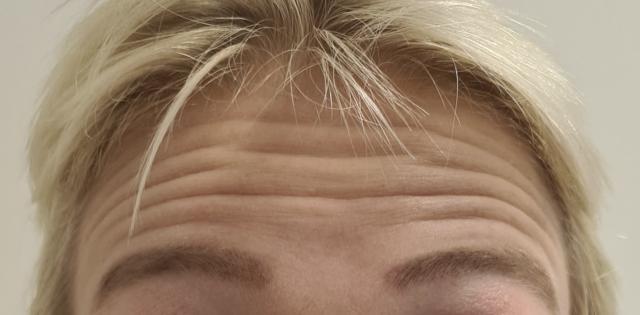
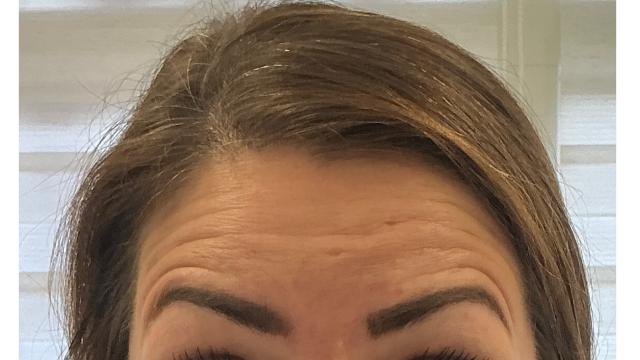
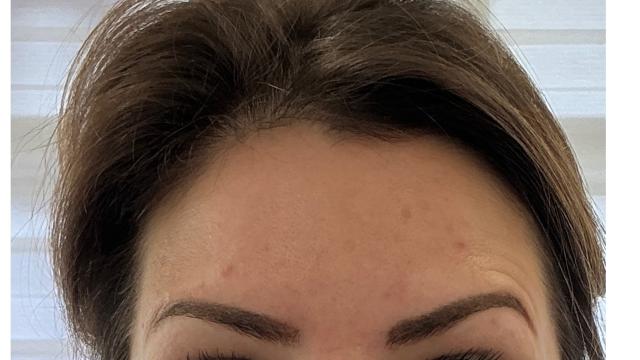
Forehead Botox before and after
Before-and-after photographs can help show the type of change that may occur after forehead Botox, but only when the images are genuinely comparable.
Look for photographs taken:
with the same facial expression;
from a similar camera angle;
at a similar distance;
under comparable lighting;
at a clearly stated point after treatment.
For movement-related forehead lines, photographs showing the eyebrows raised before and after treatment are particularly useful. Comparing a raised-eyebrow image before treatment with a relaxed forehead after treatment can make the result appear greater than it really is.
Before-and-after photographs from another person cannot predict your individual result because forehead anatomy, muscle strength, wrinkle depth, eyebrow position and treatment plans differ.
Forehead Botox before and after






Side effects, risks and aftercare
What temporary reactions can occur?
Small injection marks, redness, tenderness, mild swelling or bruising can occur around injection sites. Headache can also occur after forehead treatment.
These reactions are different from the intended reduction in frontalis movement. Contact the clinic if symptoms are unexpected, worsening or causing concern.
Can forehead Botox make the eyebrows feel heavy?
It can. The frontalis helps lift the eyebrows, so reducing its activity may temporarily change how the brow area feels or sits.
This is one reason natural eyebrow position and forehead movement should be assessed before treatment. Appropriate assessment may help treatment planning but cannot remove the possibility of side effects.
Can forehead Botox cause a drooping eyelid or eyebrow?
Temporary brow ptosis, meaning a lower eyebrow position, can occur after forehead botulinum toxin treatment. Eyelid ptosis, where the upper eyelid droops, is another recognised possible side effect.
Contact the treating clinic if you develop a noticeably lower eyebrow or eyelid after treatment.
Can the result be uneven?
Yes. The two sides of the forehead may not respond identically, and natural asymmetry that was present before treatment can remain or become easier to notice.
In some cases, the outer part of one eyebrow remains relatively active and sits higher than expected. This is sometimes referred to informally as a “Spock brow”.
A practitioner can assess a noticeable or persistent difference once the treatment effect has developed.
What aftercare should you follow?
Avoid firmly rubbing or massaging the treated forehead immediately after the injections and follow the instructions provided by your clinic.
Advice about exercise, heat, make-up or other facial treatments can differ depending on the treatment and practitioner. For a fuller explanation, see Botox aftercare.
When should you contact the clinic?
Contact your clinic if you have worsening or unexpected local symptoms, pronounced asymmetry, a noticeably lower eyebrow or eyelid, or another change after treatment that concerns you.
The clinic should explain before treatment how to reach them if you have questions or concerns afterwards.
When should you seek urgent medical help?
Rarely, the effects of botulinum toxin can spread beyond the injection area and cause more general symptoms.
Seek immediate medical attention if you develop symptoms such as difficulty breathing, difficulty swallowing, difficulty speaking or unusual widespread muscle weakness after botulinum toxin treatment.
For more detailed information about treatment risks, see Botox complications.
How much does forehead Botox cost?
The price of forehead Botox depends partly on how a clinic structures and labels its treatments. Some clinics use treatment areas or zones, but what counts as one area is not necessarily identical between providers.
When comparing a forehead Botox price, check:
exactly which area the listed price covers;
whether a consultation is included;
who carries out the prescribing assessment;
who performs the injections;
whether a review appointment is included;
which botulinum toxin product is being used;
what follow-up is available if you have a concern.
Do not assume two prices represent exactly the same treatment simply because both are described as “forehead Botox”.
For wider UK pricing information, see our guide to Botox costs.
| Treatment | Unit | City/country | Price | |
|---|---|---|---|---|
| Forehead wrinkles | zone | United Kingdom | £ 50 | Lowest price |
| Forehead wrinkles | zone | United Kingdom | £ 184 | Average price |
| Forehead wrinkles | zone | United Kingdom | £ 500 | Highest price |
Does forehead Botox need to include the frown area?
Not every forehead treatment is planned in exactly the same way. However, forehead and frown muscle activity are closely related, so a practitioner may assess both areas even when horizontal forehead lines are your main concern.
The frontalis lifts the eyebrows. Muscles in the glabellar or frown area act differently and can draw the brows inwards and downwards. The balance between these muscles can therefore influence treatment planning.
Product-specific protocols also differ. For BOTOX specifically, UK product information describes forehead-line treatment together with the glabellar area.
This does not mean that every person, product or clinic should use an identical plan. Your natural brow position, muscle activity, the product prescribed and your treatment goal all matter.
If your main concern is the vertical lines between the eyebrows rather than horizontal forehead lines, see our guide to Botox for frown lines.
How can you compare forehead Botox practitioners and clinics?
Forehead Botox requires treatment planning around both wrinkles and eyebrow movement. Comparing clinics should therefore involve more than looking at the lowest listed price.
Botulinum toxin injections such as Botox are prescription-only medicines in the UK. Before proceeding, you should understand who is responsible for prescribing the medicine and who will actually perform the injections.
Useful comparison questions include:
Who carries out the prescribing assessment?
Who will perform the injections?
What training and relevant experience do they have?
How frequently do they assess and treat the forehead and upper face?
Do they examine your forehead while your eyebrows are moving as well as at rest?
Do they discuss natural asymmetry and brow position?
Do they explain what result may not be achievable?
Which botulinum toxin product is being proposed?
What possible side effects and complications are discussed?
What aftercare and follow-up are available?
What happens if you have a concern after treatment?
What insurance arrangements are in place?
Professional registration or a job title alone does not tell you how much experience someone has with forehead treatment. Relevant anatomical knowledge, assessment, treatment planning, communication and follow-up also matter.
For more guidance, see how to compare a Botox practitioner.
Compare clinics in United Kingdom

- Forehead wrinkles from
- £ 180,00



- Forehead wrinkles from
- £ 300,00


- Forehead wrinkles from
- £ 129,00

- Forehead wrinkles from
- £ 129,00

- Forehead wrinkles from
- £ 129,00

- Forehead wrinkles from
- £ 129,00

- Forehead wrinkles from
- £ 129,00

- Forehead wrinkles from
- £ 129,00
Forehead Botox reviews
Reviews can provide context about how previous clients experienced a clinic, but they cannot predict your medical outcome or prove that a particular practitioner is appropriate for you.
For forehead Botox, useful review details may include experiences with:
the consultation;
explanation of expected movement reduction;
discussion of eyebrow position and asymmetry;
communication about risks;
price transparency;
follow-up after treatment;
how the clinic responded to questions or concerns.
A review saying that someone achieved a completely smooth forehead does not mean you will achieve the same result. Anatomy, wrinkle depth, muscle activity and treatment planning differ between individuals.
For a wider overview of patient experiences, see Botox reviews.
Reviews of forehead Botox
The range is unlimited. I’d definitely encourage anyone thinking about treatment to give this clinic a try …….. Show less »
I had lip and cheek filler and forehead botox. The procedure was handled with care and attention, and I really appreciate the aftercare support and being able to check in during the healing process. It makes a big difference, especially with treatments like this.
I’m still waiting for everything to fully settle, but so far I’m really happy with how the whole experience has been. Would definitely recommend! Show less »
The treatment itself was quick and almost painless, and Dr Saniyya was incredibly precise and gentle. What I loved most is how natural the results look – my forehead lines are softened but my face still moves naturally.
You can really tell she cares about achieving subtle, balanced results rather than overdoing it. I felt completely safe in her hands and appreciated how thorough the consultation was before the treatment.
I would highly recommend Dr Saniyya to anyone considering Botox. She is friendly, professional, and truly skilled at what she does. Show less »
Frequently asked questions about forehead Botox
Can Botox reduce forehead wrinkles?
Yes. Botulinum toxin can soften horizontal forehead wrinkles by temporarily reducing activity in the frontalis muscle. It generally has the clearest effect on lines caused by movement, while deeper lines visible at rest may remain partly visible.
Does Botox completely remove deep forehead lines?
Not necessarily. Botulinum toxin reduces the muscle movement contributing to the line but does not directly remove an established crease from the skin. Deep static lines may soften without disappearing completely.
What is the difference between dynamic and static forehead wrinkles?
Dynamic forehead wrinkles appear mainly when you raise your eyebrows. Static wrinkles remain visible when the forehead is relaxed. Botulinum toxin mainly acts on the muscle movement involved in dynamic lines.
Can forehead Botox make my eyebrows feel heavy?
Yes, a temporary heavy feeling can occur. The frontalis muscle helps raise the eyebrows, so reducing its activity may change how the brow area feels or sits.
Can forehead Botox make an eyebrow or eyelid droop?
Temporary brow or eyelid ptosis is a recognised possible side effect of forehead botulinum toxin treatment. Contact the treating clinic if you notice a clearly lower eyebrow or eyelid after treatment.
When can I see the result of forehead Botox?
The effect develops gradually. Changes may begin during the first few days, while the overall result is usually easier to assess after approximately one to two weeks.
How long does forehead Botox last?
The effect is temporary and commonly remains visible for several months, but duration varies between individuals. Muscle activity gradually returns as the effect wears off.
Is forehead Botox one zone?
Some clinics describe the horizontal forehead as one treatment area or zone, but definitions vary. Check exactly what the clinic's listed treatment and price include before comparing providers.
Do the forehead and frown area always need to be treated together?
Not every treatment plan is identical. However, forehead and frown muscle activity are related, so both areas may need to be assessed when planning forehead treatment. The product used, anatomy and individual treatment plan all matter.
How many injections are needed for forehead Botox?
There is no single injection pattern that applies to everyone. Treatment planning depends on factors such as forehead anatomy, the distribution of frontalis activity, eyebrow position and the product being used.
Can you have forehead Botox during pregnancy or breastfeeding?
Cosmetic botulinum toxin treatment is generally avoided during pregnancy, and relevant product information should be considered during breastfeeding. Discuss pregnancy, breastfeeding or plans for pregnancy with the prescriber before treatment.
When should I seek urgent medical attention after Botox?
Seek immediate medical attention if you develop symptoms such as difficulty breathing, swallowing or speaking, or unusual widespread muscle weakness after botulinum toxin treatment. These symptoms are rare but require prompt assessment.