How to choose an injectables practitioner safely

Drs. Tom van Eijk
Choosing an injectables practitioner safely means checking more than a job title, review score or social media profile. Before deciding, find out exactly who will assess and treat you, check their professional background where relevant, and ask about their training and experience with the specific treatment you are considering.
Professional registration can help confirm someone's regulated professional role, but it does not by itself show how experienced they are with cosmetic injectables or a particular treatment area.
You should also understand how the practitioner assesses you, explains risks, manages possible complications and provides aftercare.
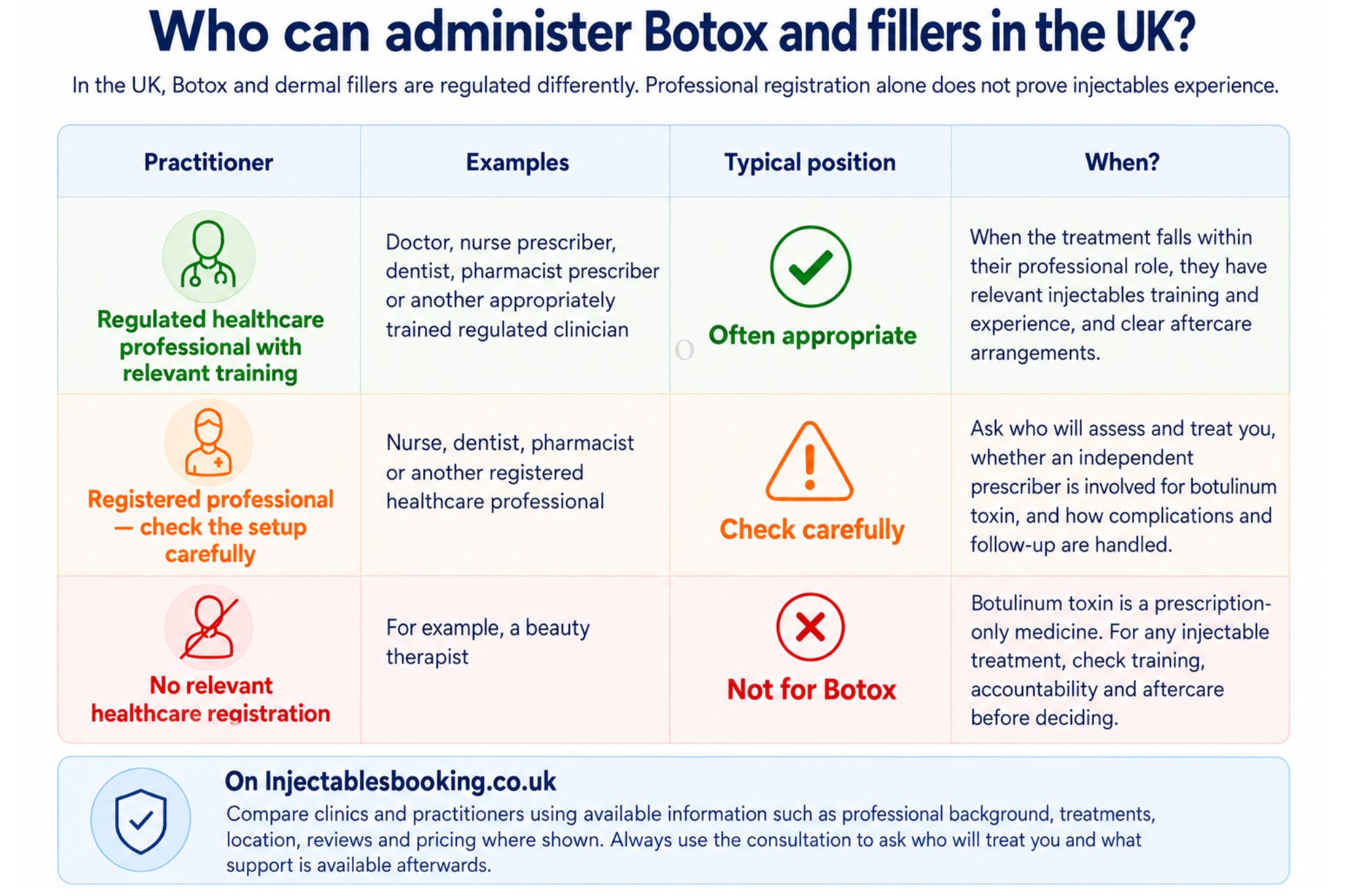
If you want a more detailed explanation of professional roles and treatment rules, read who can administer Botox and fillers in the UK.
6 checks before choosing an injectables practitioner
- 1 Confirm who will perform your treatment
- 2 Check their professional background
- 3 Ask about relevant injectables training
- 4 Check experience with your treatment
- 5 Discuss risks and complication management
- 6 Confirm aftercare and contact arrangements
Confirm who will actually perform your treatment
Do not assume that the practitioner shown on a clinic homepage, advertisement or social media account will be the person treating you.
Before making a decision, establish:
the practitioner's full name;
their professional role;
who will carry out the consultation;
who will perform the injections;
and, where relevant, whether another healthcare professional is involved in prescribing.
The information you receive when booking should be consistent with what is explained during your consultation.
For prescription-only treatments such as botulinum toxin, prescribing and administration may involve different people. You should know who is responsible for each part before treatment.
Check professional background and registration
Professional registration is useful when it applies to the practitioner's role because it allows you to verify their professional status.
It should not be treated as proof that someone has extensive experience with cosmetic injectables.
Ask what relevant injectables training the practitioner has completed and what treatments they perform regularly. Their experience should relate to the procedure you are actually considering, rather than cosmetic medicine in general.
You can also ask whether they belong to an appropriate professional or voluntary register. This may provide additional information about standards, but it should be considered alongside training, practical experience, consultation quality and aftercare.
Experience should match the treatment you are considering
Injectables experience is not one single skill.
A practitioner may regularly perform one treatment but have less experience with another. Experience may also differ between treatment areas.
For example, experience treating the lips does not automatically demonstrate the same level of experience with areas such as the tear trough, nose or temples. Similarly, experience with one type of injectable product does not automatically transfer to every other treatment.
Useful questions include:
How often do you perform this treatment?
How much experience do you have with this specific area?
What relevant training have you completed?
What are the main limitations of this treatment?
What complications are you prepared to recognise and manage?
When would you advise someone not to proceed?
There is no single number of treatments that automatically proves a practitioner is suitable. The important point is whether their training and practical experience are relevant to the treatment you are considering.
Use the consultation to assess how the practitioner works
A consultation is not only an opportunity for the practitioner to assess you. It is also your opportunity to assess the practitioner.
Before treatment, they should take time to understand relevant information such as your medical history, medicines, allergies, previous cosmetic procedures and what you would like to achieve.
You should receive a clear explanation of:
what treatment is being proposed;
why it is being considered;
what may realistically be achieved;
important limitations;
possible side effects and complications;
the product or medicine being used where relevant;
what happens after treatment;
the total cost;
and what happens if you develop a concern.
The consultation should also leave room for the answer to be no treatment. If the proposed procedure is unlikely to meet your expectations or is not appropriate in your circumstances, a responsible practitioner should be prepared to explain that.
You do not have to decide immediately.
Ask about complications and aftercare before treatment
Do not wait until after your appointment to find out what happens if you have a concern.
Before proceeding, ask:
who you should contact after treatment;
when the clinic can be contacted;
whether follow-up is available;
who assesses possible complications;
what to do outside normal opening hours;
and how the clinic handles concerns or complaints.
The exact risks and warning signs differ between injectable treatments. The practitioner should explain those that are relevant to the procedure you are considering rather than giving only generic reassurance.
Clear aftercare does not remove treatment risk, but it helps you understand what support is available if you need advice or assessment afterwards.
Other checks before choosing a practitioner
How useful are patient reviews?
Reviews can help you understand other patients' experiences with areas such as communication, consultation, organisation and aftercare. They do not prove that a practitioner is medically suitable for you and cannot predict your individual result.
Should price determine who I choose?
Price is useful comparison information, but the lowest or highest price does not by itself demonstrate practitioner quality. Compare what is included alongside relevant experience, consultation, treatment planning and aftercare.
Do professional memberships or voluntary registers matter?
They can provide additional context about standards or professional involvement. However, membership should not replace checks of the practitioner's actual role, relevant training, treatment-specific experience and aftercare arrangements.
What about social media and before-and-after photos?
Photos and social media can show the type of work a practitioner presents publicly, but they should not be your only evidence when choosing. Images cannot confirm qualifications, complication management or whether a similar result is realistic for you.
Warning signs when choosing an injectables practitioner
One concern does not automatically mean a clinic or practitioner is unsuitable, but the following are reasons to pause and ask more questions:
you cannot establish who will actually perform the treatment;
the practitioner's professional role is unclear;
relevant registration details cannot be verified where registration applies;
questions about training or treatment-specific experience are avoided;
no meaningful medical history or consultation takes place;
risks are dismissed or the treatment is described as risk-free;
you are pressured to proceed immediately;
the proposed product or medicine is unclear;
no aftercare or complication contact route is explained;
a particular cosmetic result is guaranteed.
If you are not comfortable with the information provided, you can decide not to proceed or compare another practitioner.
How to compare injectables practitioners and clinics
Once you have checked the practitioner, compare the wider clinic information as well.
Useful information can include:
the practitioners working at the clinic;
professional roles and registration information where shown;
treatments offered;
clinic location;
patient reviews;
available treatment prices;
consultation options;
and booking information.
Do not reduce the comparison to one rating or one price. Look for information relevant to the exact treatment you are considering and use the consultation to verify anything that remains unclear.
Injectablesbooking brings available practitioner and clinic information together so you can compare options before deciding whether to request a consultation.
Compare injectables clinics near you
Compare on experience & price Make an appointment immediately
Frequently asked questions about choosing an injectables practitioner
How do I check an injectables practitioner?
Start by confirming exactly who will treat you. Check their professional background and registration where relevant, then ask about injectables training, experience with your specific treatment, complication management and aftercare.
Is professional registration enough?
No. Registration can confirm someone's professional status where applicable, but it does not show how much training or practical experience they have with a particular injectable treatment.
How much injectables experience should a practitioner have?
There is no single number that proves someone is suitable. Ask how regularly they perform your specific treatment and how much experience they have with the anatomical area you are considering.
What should I ask during an injectables consultation?
Ask about the proposed treatment, realistic outcome, limitations, relevant risks, practitioner experience, product or medicine where applicable, total cost, aftercare and what happens if a complication occurs.
Can reviews tell me whether a practitioner is safe?
Reviews provide information about other people's experiences, but they do not prove clinical competence or predict your own treatment outcome.
Do I have to decide during the consultation?
No. You can take time to consider the information provided and decide not to proceed if you are uncertain or uncomfortable.
Should I choose the cheapest injectables practitioner?
Price can be compared, but it should not be the only factor. Relevant training, treatment experience, consultation quality, complication arrangements and aftercare also matter.
Why does experience with the treatment area matter?
Different treatments and anatomical areas require different knowledge and practical experience. Ask specifically about the procedure and area you are considering rather than injectables experience in general.