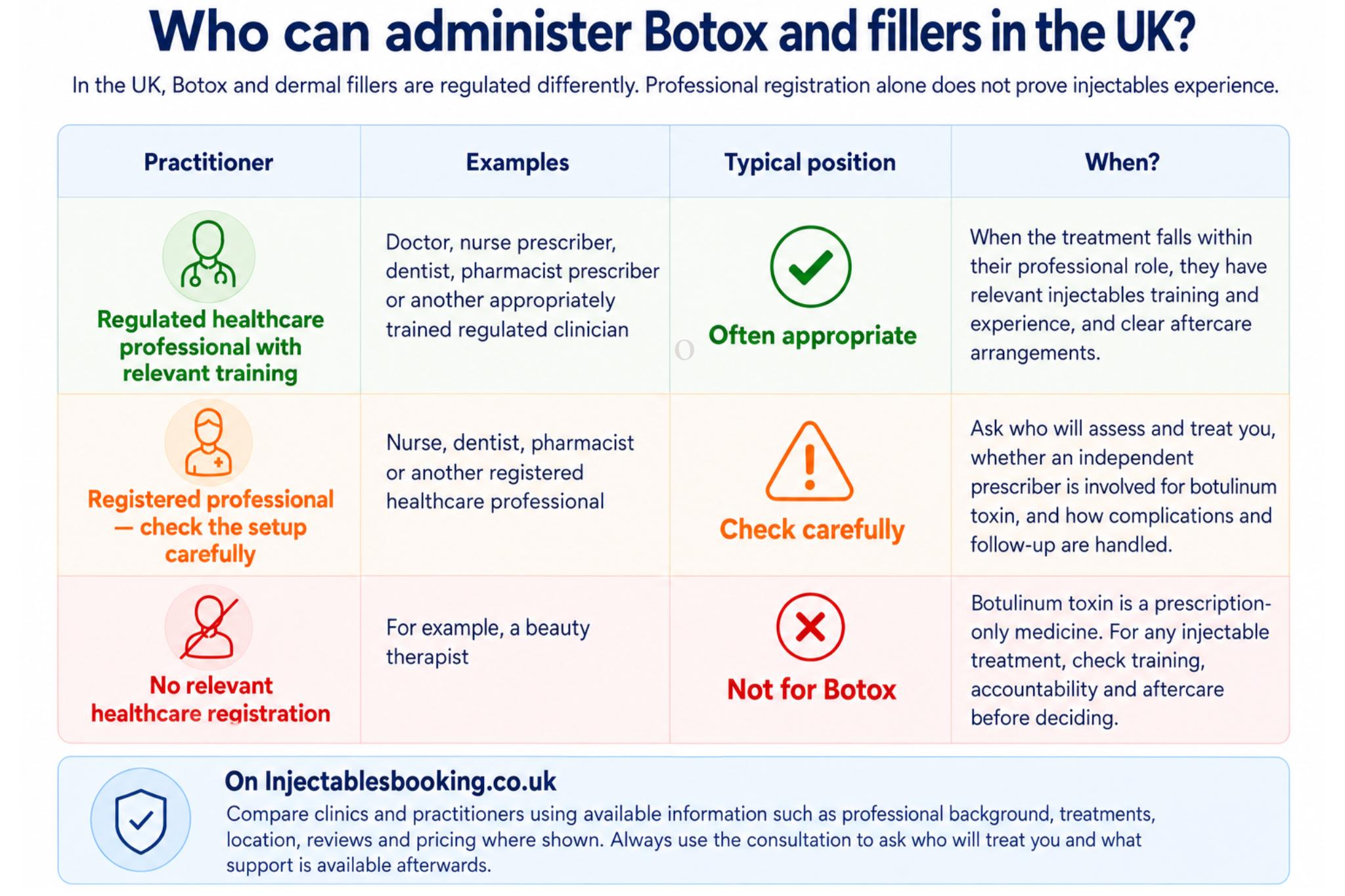
Who can administer Botox and fillers in the UK?

Drs. Tom van Eijk
The rules depend on the injectable treatment and the role of the practitioner.
Botulinum toxin, including Botox®, is a prescription-only medicine. It must be prescribed following an appropriate consultation and assessment. The person giving the injections does not necessarily have to be the prescriber, but the prescriber must be satisfied that the injector is appropriately trained and safe to carry out the treatment.
Dermal fillers are different. They generally do not require a prescription. This makes it particularly important to check the person performing the treatment, their relevant training and experience, insurance and professional registration where applicable.
Professional registration is useful, but it does not by itself show how much experience someone has with Botox, fillers or a particular treatment area.
How to check an injectables practitioner
- 1 Check their professional registration where applicable
- 2 Ask about injectables-specific training
- 3 Check experience with your treatment
- 4 Ask who prescribes your botulinum toxin
- 5 Ask how complications are managed
- 6 Check insurance and aftercare arrangements
Who can prescribe Botox in the UK?
Botox® is one brand of botulinum toxin. Botulinum toxin products used for cosmetic injections are prescription-only medicines, so there must be an appropriate prescription before treatment.
The prescribing professional should assess whether the medicine is appropriate for the individual patient. Professional rules also apply to how cosmetic injectable medicines are prescribed. For example, GMC guidance requires doctors to physically examine a patient before prescribing injectable cosmetic medicines and does not permit remote prescribing for these medicines.
NMC rules require independent nurse and midwife prescribers to carry out a face-to-face consultation and appropriate clinical assessment before prescribing medicines used for elective non-surgical cosmetic procedures.
For a broader explanation of the treatment itself, see the Botox guide.
Does the Botox prescriber have to give the injections?
Not necessarily.
The NHS states that the person administering botulinum toxin does not have to be the same person who prescribed it. However, the prescriber must make sure that the person administering the injections is trained and safe to do so.
Before treatment, you should therefore know both who is prescribing the medicine and who will actually perform the injections.
Who can administer dermal fillers?
Dermal fillers do not follow the same prescription rules as botulinum toxin. Injectable dermal fillers generally do not require a prescription.
That does not mean the practitioner's background is irrelevant. Before having filler treatment, check:
what training they have completed;
how much experience they have with fillers;
whether they regularly treat the specific anatomical area;
what product they intend to use;
how they identify and manage complications;
what aftercare is available;
whether they have appropriate insurance.
Where a practitioner says they are a doctor, dentist, nurse or another regulated healthcare professional, their professional registration can also be independently checked.
For more information about the treatment itself rather than practitioner eligibility, see the dermal fillers guide.
How do you check whether a practitioner is registered?
If the practitioner claims to belong to a regulated healthcare profession, check the relevant official professional register rather than relying only on a clinic website or social-media profile.
For example:
doctors can be checked through the General Medical Council (GMC);
nurses and midwives can be checked through the Nursing and Midwifery Council (NMC);
dentists can be checked through the General Dental Council (GDC).
Check that the name and professional details correspond with the person who will actually assess or treat you.
Some cosmetic practitioners may also appear on voluntary registers such as Save Face or the Joint Council for Cosmetic Practitioners. These can provide additional information, but they should not be confused with statutory professional registration.
Does professional registration prove someone is experienced with injectables?
No. Registration confirms information about a practitioner's regulated professional status where applicable. It does not tell you how many Botox or filler procedures they have performed or how much experience they have with your particular treatment area.
For injectables, look separately at:
relevant aesthetic training;
experience with the specific injectable;
experience with the anatomical area;
how treatment suitability is assessed;
how risks and limitations are explained;
aftercare arrangements;
how complications are managed.
Reviews may provide useful context about communication, consultation and aftercare, but they do not prove that a practitioner is medically suitable for your treatment or guarantee a particular result.
For a broader practitioner-comparison checklist, see how to choose a cosmetic practitioner.
UK regulation of cosmetic injectables
Are the rules the same throughout the UK?
Not completely. Regulation of non-surgical cosmetic procedures differs between UK nations and is changing. The practical checks on this page — identifying the prescriber where relevant, checking professional registration, relevant training, experience, insurance and aftercare — remain useful when comparing practitioners.
What is changing in England?
England has proposed a licensing system for non-surgical cosmetic procedures, including practitioner and premises licensing. The scheme should not be described as already operating until the relevant licensing requirements have entered into force.
What is changing in Scotland?
Scotland passed legislation in March 2026 covering higher-risk non-surgical procedures including Botox and fillers. The Scottish Government has stated that the relevant offences cannot come into force before September 2027, allowing an implementation period before the new requirements apply.
What should you ask before an injectable treatment?
Before deciding whether to proceed, make sure you know who is responsible for each part of your care.
Useful questions include:
Who will carry out my consultation?
Who will prescribe the medicine if a prescription is required?
Who will perform the injections?
What professional registration does the practitioner hold, if applicable?
What training have they completed for this treatment?
How often do they perform this particular procedure?
What happens if I experience a complication?
Who provides follow-up care?
What insurance arrangements are in place?
You do not have to proceed simply because you have attended a consultation. Take the information you have been given into account before deciding whether treatment is right for you.
Compare injectables practitioners in the UK
Once you have checked the practitioner's role, registration where relevant, training and treatment-specific experience, you can compare practitioners who offer cosmetic injectables in the UK.
Look at the individual practitioner rather than assuming that every person working at the same clinic has identical qualifications or experience.
Cosmetic specialists in United Kingdom

- Botox zone from
- £ 180,00
- Filler per ml from
- £ 250,00

- Botox zone from
- £ 300,00
- Filler per ml from
- £ 450,00

- Botox zone from
- £ 129,00
- Filler per ml from
- £ 250,00

- Botox zone from
- £ 129,00
- Filler per ml from
- £ 250,00

- Botox zone from
- £ 135,00
- Filler per ml from
- £ 210,00

- Botox zone from
- £ 135,00
- Filler per ml from
- £ 210,00

- Botox zone from
- £ 135,00
- Filler per ml from
- £ 210,00

- Botox zone from
- £ 135,00
- Filler per ml from
- £ 210,00
Frequently asked questions about injectables practitioners
Does the person prescribing Botox have to inject it?
No. The injector can be different from the prescriber. However, the prescriber must be satisfied that the person administering the botulinum toxin is appropriately trained and safe to perform the treatment.
Do dermal fillers need to be prescribed?
Dermal fillers generally do not require a prescription. Check the injector's relevant training, experience, insurance and professional registration where applicable.
How can I check whether a doctor is registered?
Doctors can be searched on the General Medical Council's register. Check that the registration details correspond with the person who will assess or treat you.
How can I check a nurse or dentist?
Nurses and midwives can be checked through the Nursing and Midwifery Council, while dentists can be checked through the General Dental Council.
Does professional registration mean someone is experienced with Botox or fillers?
No. Registration and injectables experience are separate. Ask about relevant training, how often the practitioner performs the treatment and their experience with the specific anatomical area.
Should I know who is prescribing my Botox?
Yes. Before treatment, you should know who is prescribing the botulinum toxin and who will administer it, as these may be different people.
Can I decide not to proceed after a consultation?
Yes. A consultation is an opportunity to understand the proposed treatment, practitioner and risks. You can decide not to proceed if you are not comfortable with the information provided.