Chin fillers, the treatment that makes the difference
The chin plays a bigger role in the face than many people realize. A recessed, short, or asymmetrical chin can disrupt facial balance and influence how the jawline, lips, and nose are perceived. As a result, the profile may appear less strong or harmonious.
With a chin filler treatment, the shape, projection, and symmetry of the chin can be subtly improved. By adding hyaluronic acid fillers, better proportions between different facial structures can be achieved—without the need for surgery.
Because the anatomy of the chin is complex and small differences can have a significant impact, the experience and technique of the doctor are crucial. Comparing doctors and clinics helps you make a safe and well-informed choice.

What You Should Know About Chin Fillers
Chin fillers improve the projection, shape, and symmetry of the chin.
They create better balance between the chin, jawline, and nose.
The result is visible immediately and continues to refine over the following days.
The treatment takes an average of 20 to 30 minutes.
The effect usually lasts between 9 and 18 months.
The treatment is non-surgical and temporary.
Comparing providers helps you find a doctor with anatomical expertise.
Why Results and Experiences with Chin Fillers May Differ
Why does the result of chin fillers look different for everyone?
The result of chin fillers varies from person to person due to differences in bone structure, skin thickness, and the degree of volume loss. A hyaluronic acid-based filler is used to improve projection and contour by adding volume. When the underlying jaw structure and soft tissues differ, the profile responds differently to volume enhancement. With a strong bony foundation, a small amount may already create a noticeable effect, while a recessed chin may require more correction. As a result, the level of projection and profile balance varies for each individual.
Why does one person need more chin filler than another?
The required amount of chin filler differs per person due to variations in bone projection, jaw position, and tissue volume. The chin forms the foundation of the lower face and determines the proportion between the nose, lips, and jawline. When the chin is significantly recessed or when there is greater tissue loss, more hyaluronic acid is needed to create sufficient projection. In cases requiring mild correction, a smaller amount is enough to enhance facial balance. Therefore, the required dosage varies by individual.
Why does the injection technique for chin fillers differ between doctors?
The injection technique for chin fillers differs between doctors due to variations in training, experience, and treatment strategy. The chin can be treated at different anatomical levels, such as supraperiosteal placement for projection or subcutaneous placement for contour refinement. The chosen technique determines how the hyaluronic acid spreads and how pressure is distributed across surrounding structures. Preferences may also vary regarding the use of a needle or cannula and point versus linear injection methods. As a result, the approach may differ per doctor, influencing shape, stability, and risk distribution.
Why do chin filler prices vary between clinics?
Chin filler prices vary between clinics due to differences in product quantity, purchasing costs, and practitioner expertise. The total cost depends on the number of milliliters of hyaluronic acid required to achieve sufficient projection and contour. Consultation time, medical responsibility, and operational expenses also affect pricing. Clinics with higher fixed costs or highly specialized doctors often charge higher fees to cover these expenses. This leads to price variation between clinics for the same treatment.
Why is comparing chin fillers important?
Comparing chin fillers is important because product choice, injection technique, and practitioner experience differ between clinics. The chin plays a key role in lower facial balance, making precise anatomical assessment essential. Variations in placement and dosage affect the degree of projection and contour formation. Pricing structures and product quantities also differ between practices. Comparing options provides insight into factors that influence safety, treatment strategy, and the final facial proportions.
What Are Chin Fillers & How Do They Work?
Chin Fillers at a Glance
Type of treatment: Injectable filler
Purpose: Improve chin projection and overall facial balance
Visible results: Yes
Average duration: 20–30 minutes
Key success factor: Understanding of facial proportions
What exactly do chin fillers do?
Chin fillers consist of hyaluronic acid and are injected either deeply onto the bone or into the surrounding tissue. They provide structure, support the facial profile, and improve balance in the lower face.
How does a chin filler treatment work?
Preparation: Analysis of the facial profile and the jaw-to-chin ratio.
Treatment: Targeted injections at strategic points.
Immediately after: Mild swelling or tenderness may occur.
Are chin fillers permanent?
No, the effect is temporary and gradually diminishes over time.
What Can Go Wrong During a Chin Filler Treatment?
As with other filler treatments, side effects can occur with chin fillers. The most common reactions are temporary swelling, redness, or small bruises around the treated area. These usually resolve within a few days. In rare cases, complications may arise, for example due to incorrect filler placement or insufficient knowledge of chin and jawline anatomy. The risk is determined less by the type of filler and more by the doctor’s experience, technique, and proper patient selection. That is why it is important to carefully compare doctors and clinics before undergoing treatment.
Which Side Effects Are Most Common with Chin Fillers?
After a chin filler treatment, you may experience mild swelling, redness, tenderness, or bruising. These side effects are generally mild and temporary. The chin may feel tight or sensitive during the first few days, especially when touched or moved. For most people, these symptoms subside on their own within a few days to a week. Cooling the area and following aftercare instructions can help speed up recovery.
Can the Chin Feel Hard After Chin Fillers?
Yes, during the initial period the chin may feel firmer or harder than expected. This is normal and related to the filler integrating into the surrounding tissue. As swelling decreases and the product settles, the area usually feels softer and more natural. This process can take one to two weeks. A persistently hard area may indicate filler accumulation and should be assessed by a doctor.
Is Asymmetry Possible After Chin Fillers?
Asymmetry can occur, especially in the first few days after treatment. This is often caused by temporary swelling, which may be more pronounced on one side than the other. In most cases, this resolves naturally. Persistent asymmetry may result from anatomical differences or less optimal filler placement. An experienced doctor takes this into account and typically evaluates the final result after one to two weeks, when adjustments can be made if necessary.
When Should You Contact a Doctor After Chin Fillers?
It is important to contact your treating doctor if you experience persistent pain, increasing swelling, clear or worsening asymmetry, skin discoloration, or unusual sensations such as tingling or intense pressure. This is especially important if symptoms do not improve or worsen after the first few days. Early evaluation can help prevent complications and ensure a safer recovery.
Can Chin Fillers Be Dissolved?
Yes, chin fillers based on hyaluronic acid are reversible. Using a specific enzyme (hyaluronidase), the filler can be partially or completely dissolved. This may be necessary in cases of an undesirable result, asymmetry, or medical complications. The ability to dissolve the filler is often considered an important safety advantage of hyaluronic acid fillers and provides additional reassurance during treatment.
Popular Chin Filler Treatments
Chin projection enhancement: A stronger, more defined profile
Chin lengthening: Improved facial proportions
Chin widening: Better balance for a narrow chin
Asymmetry correction: A more even and harmonious shape
Chin Fillers: Results, Duration & Safety
Chin fillers provide:
Better profile balance
A stronger jaw-to-chin transition
More harmony in the face
Average duration: 9 to 18 months
Safety depends on:
The experience of the doctor
The depth and injection technique used
Anatomical knowledge
Chin fillers before and after photos


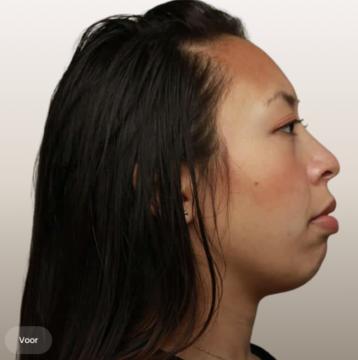
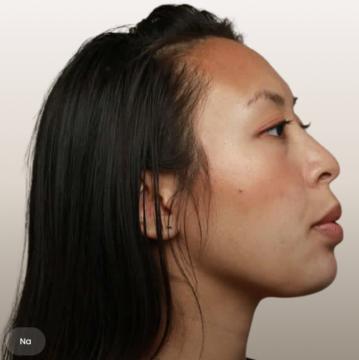


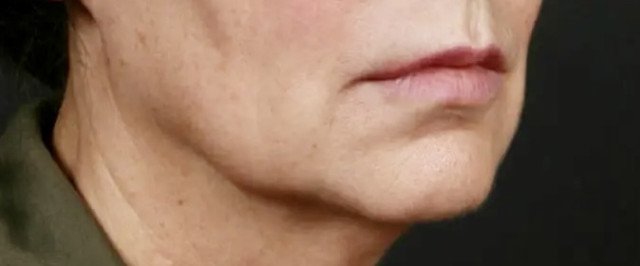


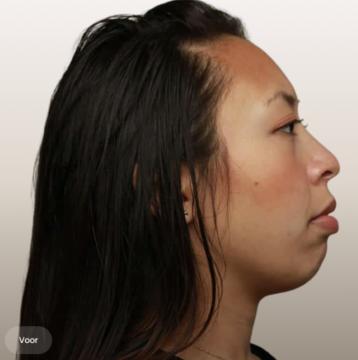
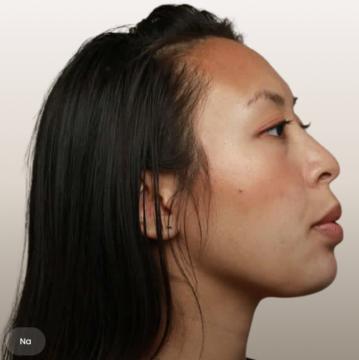
How Long Do Chin Fillers Last & Aftercare
On average, 9 to 18 months.
Aftercare:
Do not press or massage the area.
Avoid intense exercise for 24 hours.
Avoid sleeping on your chin.
Chin Fillers: Who Is Suitable / Less Suitable
Suitable if:
You want to improve your facial profile.
Your chin is small or recessed.
You are looking for a non-surgical solution.
Less suitable if:
You are pregnant or breastfeeding.
You have active skin infections.
How Do You Determine If Chin Fillers Are Right for You?
- 1 Does the balance of your profile bother you?
- 2 Do you want a subtle or a more noticeable correction?
- 3 Are you open to a temporary result?
- 4 Do you have realistic expectations?
- 5 Are you choosing an experienced doctor?
Chin Fillers: Prices, Experiences & Comparison
Average price per ml of chin filler: approximately £260 – £615 (based on the current exchange rate).
The required amount varies depending on your facial profile and the degree of correction needed.
Comparing providers helps you choose quality, expertise, and safety.
| Treatment | Unit | City/country | Price | |
|---|---|---|---|---|
| Chin fillers | ML | United Kingdom | £ 70 | Lowest price |
| Chin fillers | ML | United Kingdom | £ 248 | Average price |
| Chin fillers | ML | United Kingdom | £ 800 | Highest price |
Compare prices near you.
Compare on experience & price Make an appointment immediately
Chin filler experiences: what do people pay attention to?
A natural-looking profile
Symmetry
Clear explanations
Trust in the doctor
Transparent pricing
Chin Fillers Compared with Alternatives
Chin fillers vs. chin implants: Temporary versus surgical
Chin fillers vs. jawline fillers: Focal enhancement versus contour framing
Chin fillers vs. orthodontics: Aesthetic correction versus functional treatment
Compare Chin Filler Doctors & Clinics
Compare based on:
Experience with chin fillers
Profile analysis
Results
Reviews
Cosmetic specialists in United Kingdom

- Botox zone from
- £ 180,00
- Filler per ml from
- £ 250,00

- Botox zone from
- £ 300,00
- Filler per ml from
- £ 450,00

- Botox zone from
- £ 129,00
- Filler per ml from
- £ 250,00

- Botox zone from
- £ 129,00
- Filler per ml from
- £ 250,00

- Botox zone from
- £ 135,00
- Filler per ml from
- £ 210,00

- Botox zone from
- £ 135,00
- Filler per ml from
- £ 210,00

- Botox zone from
- £ 135,00
- Filler per ml from
- £ 210,00

- Botox zone from
- £ 135,00
- Filler per ml from
- £ 210,00
Differences in Chin Fillers Between Clinics
Treatment philosophy
Injection technique
Aftercare
Pricing structure
Compare clinics in United Kingdom

- Botox zone from
- £ 180,00
- Filler per ml from
- £ 250,00
- Profhilo per 2 ml from
- £ 300,00



- Botox zone from
- £ 300,00
- Filler per ml from
- £ 450,00
- Profhilo per 2 ml from
- £ 400,00


- Botox zone from
- £ 129,00
- Filler per ml from
- £ 250,00
- Profhilo per 2 ml from
- £ 195,00

- Botox zone from
- £ 135,00
- Filler per ml from
- £ 210,00
- Profhilo per 2 ml from
- £ 325,00

- Botox zone from
- £ 129,00
- Filler per ml from
- £ 250,00
- Profhilo per 2 ml from
- £ 195,00

- Botox zone from
- £ 129,00
- Filler per ml from
- £ 250,00
- Profhilo per 2 ml from
- £ 195,00

- Botox zone from
- £ 129,00
- Filler per ml from
- £ 250,00
- Profhilo per 2 ml from
- £ 195,00

- Botox zone from
- £ 129,00
- Filler per ml from
- £ 250,00
- Profhilo per 2 ml from
- £ 195,00
Frequently Asked Questions About Chin Fillers
Does a chin filler really make a big difference?
Yes, a chin filler can create a noticeable yet natural difference. By adding projection or length to the chin, facial balance improves and the jawline often appears more defined. Especially in cases of a recessed or short chin, the effect can be clearly visible—without looking overdone when the correct dosage is used.
Can a chin filler migrate?
Migration of a chin filler is rare. The chin is a stable area with limited muscle movement, which helps fillers stay in place. Migration may occur in cases of overcorrection, use of a filler that is too soft, or incorrect injection technique. Treatment by an experienced doctor significantly reduces this risk.
Which fillers are best for the chin?
For the chin, firm hyaluronic acid fillers specifically designed for contour and structure are typically used. These fillers provide sufficient lift and stability, ensuring a defined and long-lasting result. The choice of product depends on individual anatomy and the desired outcome.
Is a chin filler different from other fillers?
Yes. Fillers for the chin often differ in firmness and cohesiveness compared to fillers used for lips or fine lines. Chin fillers are designed to provide structure and projection, whereas lip fillers are generally softer and more flexible.
Can fillers correct a recessed chin?
Yes, chin fillers are a commonly used and effective non-surgical solution for a recessed chin. They improve projection and profile balance, creating a more harmonious facial appearance. In cases of severe recession, surgical correction may sometimes be more appropriate.
Why is a chin filler relatively expensive?
A chin filler is often more expensive because it may require a larger amount of product, deeper injections, and a high level of anatomical knowledge. It is a technically complex treatment where precision is essential to achieve a natural and safe result.
How long does a chin filler last?
A chin filler typically remains visible for an average of 12 to 18 months. In some cases, results may last up to 24 months, depending on the type of filler used, your metabolism, and lifestyle factors.
What is the difference between chin fillers and a chin implant?
Chin fillers are temporary and non-surgical, while a chin implant is a permanent surgical procedure. Fillers offer flexibility and minimal downtime, whereas implants provide a long-term structural solution.
Can you get a chin filler during pregnancy or breastfeeding?
No, a chin filler treatment is not recommended during pregnancy or breastfeeding due to the lack of sufficient safety studies.
When can you return to work or exercise after a chin filler?
You can usually return to work immediately after the treatment. However, intense exercise, pressure on the chin, and heat exposure (such as saunas) are not recommended during the first 24 hours.
A chin filler treatment is a safe and effective way to improve facial balance and profile without surgery. The result is immediately visible, natural-looking, and temporarily adjustable. By comparing doctors and clinics, you gain insight into experience, technique, and costs contributing to a safe and aesthetically pleasing outcome.