Rejuran Treatment

Drs. Tom van Eijk
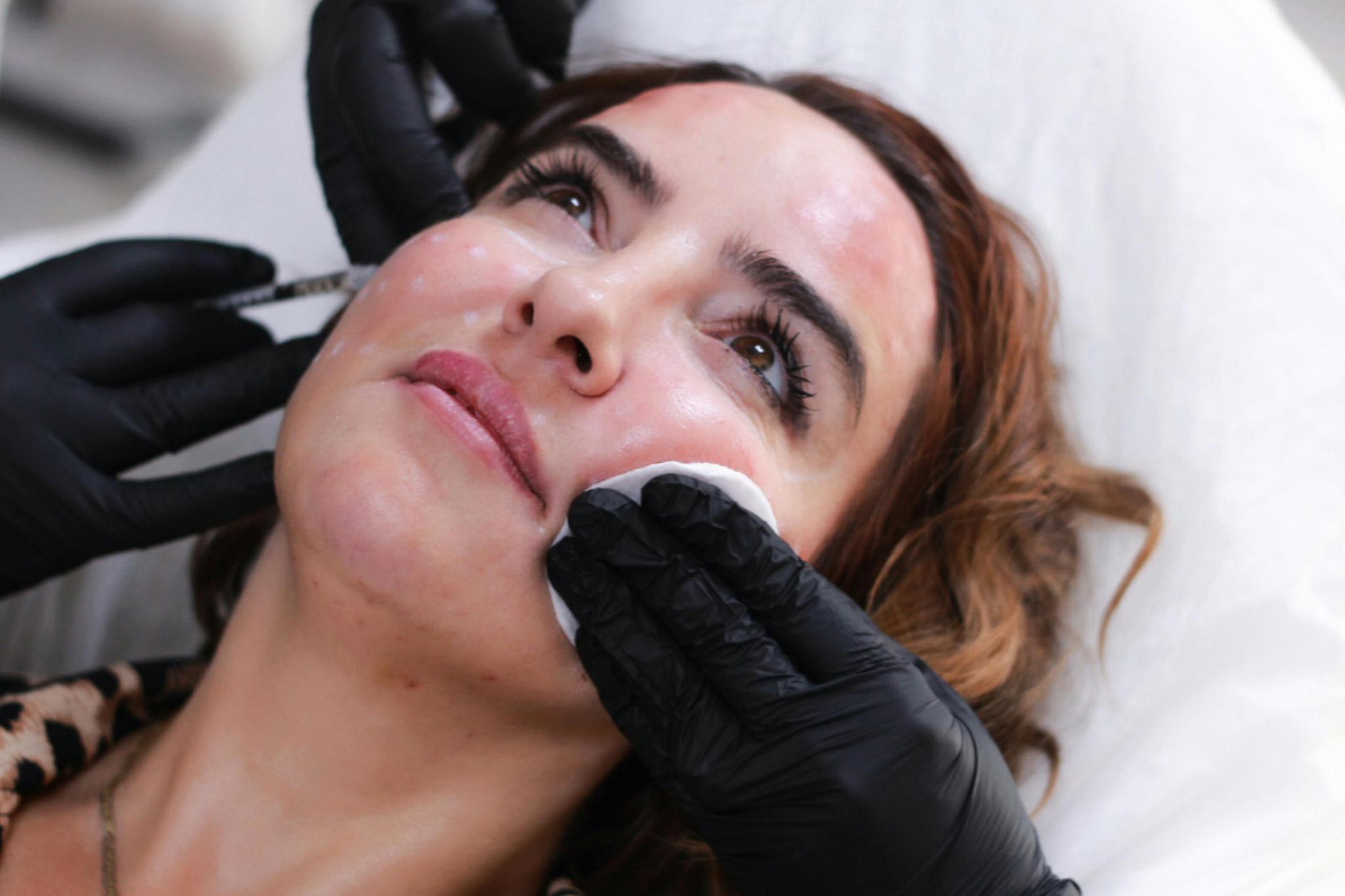
A Rejuran treatment involves multiple small injections of a polynucleotide (PN) product into selected areas of the skin. Before treatment, the practitioner should assess your treatment goal, medical history, skin and treatment area, then explain which Rejuran product is being proposed and why.
Rejuran is primarily used as a skin-quality treatment rather than to create the immediate volume or contour associated with a conventional dermal filler. Changes are usually assessed gradually, and there is no single treatment protocol or result timeline that applies to everyone.
This page explains the treatment itself: what should happen at consultation, how the injections are performed, what to expect afterwards and what to compare between clinics. For a broader introduction to the treatment category, see the Rejuran guide.
What is a Rejuran treatment?
Rejuran is a brand of injectable products containing polynucleotides, usually shortened to PN. The product is introduced into the skin through a series of small injections rather than being placed primarily to build facial volume.
The treatment is generally discussed when the aim is to address aspects of skin quality, such as texture, elasticity, hydration or the appearance of certain fine lines. How much visible change occurs varies between individuals, and the available research does not support a guaranteed cosmetic result.
How are polynucleotides involved?
Polynucleotides are DNA-derived chains of nucleotides. They are being studied in aesthetic medicine because of their possible effects on processes involved in tissue quality and the extracellular matrix.
The biological explanation is more complex than saying Rejuran simply "creates collagen". Clinical research remains limited and uses different products, techniques and treatment protocols. You can read the more detailed scientific explanation in our guide to Rejuran polynucleotides.
Is Rejuran a filler?
Rejuran is not used like a conventional volumising dermal filler. Its primary purpose is not to project the cheeks, reshape the chin or create immediate structural volume.
This distinction matters during consultation. If your main concern is caused by significant volume loss, facial structure or another underlying factor, the practitioner may discuss a different approach rather than assuming Rejuran is appropriate.
What should happen before a Rejuran treatment?
A Rejuran treatment should begin with an assessment rather than with the injections themselves. The consultation should establish what you want to change, whether that goal is realistic and what product and treatment plan are being proposed.
The practitioner should ask about relevant aspects of your medical history. This may include current medical conditions, medicines and supplements, allergies, active skin problems, pregnancy or breastfeeding and previous unexpected reactions to injectable treatments.
You should also know the exact treatment area being proposed. "Full face", "under eyes" or another description should not be treated as interchangeable because skin thickness, anatomy, technique and treatment goals can differ between areas.
What should you ask about the Rejuran product?
Ask the practitioner:
which specific Rejuran product will be used;
why that formulation has been selected;
where it will be injected;
what the proposed treatment is intended to change;
what it is unlikely to change;
how the result will be assessed;
what the main risks are for that treatment area.
A brand name alone does not establish that a treatment is appropriate for you.
Should you decide immediately?
No. A consultation should give you enough information to make your own decision. You can ask further questions, seek another opinion, postpone treatment or decide not to proceed.
What happens during a Rejuran treatment?
- 1 Consultation and assessment
- 2 Confirm the treatment goal and treatment area
- 3 Identify the Rejuran product being proposed
- 4 Clean and prepare the skin
- 5 Discuss comfort measures where appropriate
- 6 Administer multiple small injections
- 7 Check the treated area after injection
- 8 Explain aftercare and warning signs
- 9 Arrange reassessment if appropriate
How are Rejuran injections performed?
Rejuran is usually administered using multiple small injections across the selected treatment area. The exact injection pattern, depth, amount and technique can vary according to the product, anatomy, skin characteristics and treatment plan.
Small raised bumps or papules may be visible at some injection points immediately afterwards. This reflects the injection process and does not by itself indicate the final cosmetic result.
Does Rejuran treatment hurt?
Multiple injections can feel uncomfortable, sharp or sensitive. The experience varies between individuals and treatment areas.
Ask the clinic before your appointment what comfort measures they use and what you should expect. It is better to understand their normal process beforehand than assume that treatment will be painless.
How long does the appointment take?
Appointment length can differ depending on consultation requirements, treatment area, preparation and injection technique. A clinic should be able to explain how much time it normally allocates for the consultation and treatment rather than relying on a universal treatment time.
How is a Rejuran treatment plan decided?
There is no single Rejuran course that is appropriate for everyone. Published polynucleotide studies use different numbers of sessions, treatment intervals, injection techniques and follow-up periods.
A proposed treatment plan should therefore have a reason behind it.
Ask:
why that number of sessions is being proposed;
why those intervals have been chosen;
when the result will be reviewed;
what would justify another treatment;
what happens if there is little visible change.
More treatment is not automatically better. Reassessment is particularly important when the expected change is subtle or when you are uncertain whether the original goal is being achieved.
Do you always need a course of treatments?
Not necessarily in the sense of one universal predetermined course. Some protocols involve repeated sessions, but the evidence does not establish one fixed number that every person needs.
A clinic should be able to explain its proposed protocol rather than simply stating that everyone requires the same package.
When can you assess the results of Rejuran?
Rejuran is not intended to produce the same immediate volumising change as a dermal filler. Any improvement in skin quality is generally assessed over time rather than from how the skin looks immediately after injection.
There is no reliable point at which every person should see the same result. Product choice, treatment area, starting skin condition, injection protocol and individual response can all affect the assessment.
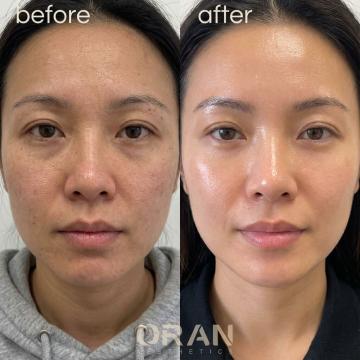
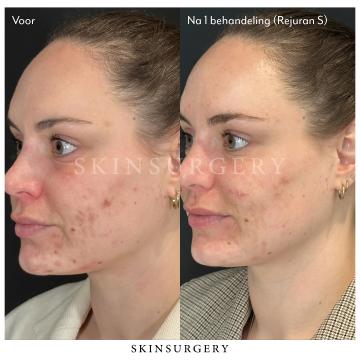
If photographs are used, comparisons are more useful when lighting, camera position, expression and distance remain consistent. See our dedicated guide to Rejuran before and after for a more detailed explanation of how treatment photographs should be interpreted.
What changes might be assessed?
Depending on the original treatment goal, assessment may consider aspects such as:
skin texture;
the appearance of certain fine lines;
elasticity;
hydration;
overall visible skin quality.
These are possible assessment areas rather than guaranteed outcomes.
Rejuran before and after photos
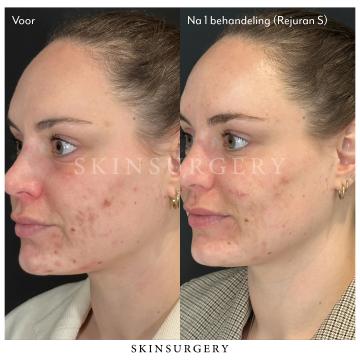
What should you expect after Rejuran treatment?
Temporary injection-site reactions can occur after Rejuran. These may include redness, swelling, tenderness, small raised bumps at injection points or bruising.
How noticeable these reactions are and how long they remain visible can vary between people, treatment areas and injection techniques.
Your clinic should tell you what it considers expected after your specific treatment, what aftercare it recommends and how to contact the team if something does not develop as expected.
For a more detailed timeline and practical aftercare information, see Rejuran recovery.
Rejuran risks and recovery questions
What side effects can happen after Rejuran?
Temporary local reactions reported after injectable polynucleotide treatment include redness, swelling, tenderness, raised injection points and bruising.
The available studies are relatively small, so an absence of frequent serious events in published research should not be interpreted as proof that complications cannot occur.
For a more detailed explanation of possible reactions and complications, see Rejuran side effects.
When should you contact the clinic?
Contact the treating clinic if pain or swelling is becoming substantially worse rather than settling, if you develop an unexpected change in skin colour, possible signs of infection, or another reaction that differs from what you were told to expect.
Severe or rapidly developing symptoms require prompt medical assessment.
Are serious complications impossible?
No injectable treatment should be described as completely risk-free. Published studies of cosmetic polynucleotide injections have generally reported temporary local reactions, but the evidence base remains limited.
Ask the practitioner which complications are relevant to the exact product, injection technique and anatomical area being treated.
When might treatment be postponed?
Tell the practitioner about active infection or inflammation around the treatment area, relevant medical conditions, medicines or supplements, allergies, pregnancy or breastfeeding and previous unexpected reactions to injectable treatments.
The practitioner should use this information when deciding whether treatment can proceed, should be postponed or may not be appropriate.
What aftercare information should the clinic provide?
You should leave knowing what reactions are expected, what you should avoid or modify temporarily, when normal skincare and activities can resume according to the clinic's protocol, and who to contact if you have concerns.
Generic online aftercare should not replace instructions relating to your actual treatment.
What if you see little or no change after Rejuran?
Seeing little visible change does not automatically mean that another session should be performed immediately. First consider when the treatment was carried out, what was treated, which product was used and what the original treatment goal was.
The next step should be reassessment rather than automatically increasing the number of injections.
If the expected assessment period has passed and the difference remains limited, our guide to Rejuran not working explains the main questions to review before deciding what to do next.
How much does a Rejuran treatment cost?
The price of Rejuran can differ between UK clinics according to factors such as the treatment area, product, amount used and proposed treatment plan.
When comparing prices, check what the figure actually represents. A price for one session is not necessarily the total cost of a proposed multi-session treatment plan.
Check:
which treatment area is included;
which Rejuran product is being used;
whether the quote relates to one session or a wider course;
whether consultation or follow-up is included;
whether different clinics are quoting on the same basis.
For dedicated UK pricing information, use the Rejuran costs guide.
How do you compare clinics for Rejuran treatment?
Compare more than the headline price. The consultation, practitioner, proposed product, treatment plan and arrangements for follow-up all affect the treatment experience.
Before proceeding, establish:
who will perform the treatment;
what relevant clinical training and Rejuran experience they have;
whether they regularly treat the anatomical area involved;
which exact Rejuran product they intend to use;
why that product and technique have been proposed;
how benefits and limitations are explained;
which risks are relevant to your treatment;
how results will be assessed;
who you can contact if you have a concern afterwards.
A professional title or registration, where applicable, does not by itself demonstrate extensive experience with Rejuran or a particular facial area.
Our guide to choosing a practitioner for Rejuran covers practitioner comparison in more detail.
What are useful signs during a consultation?
A useful consultation should leave you with a clear understanding of the proposed treatment rather than pressure to proceed.
You should be able to explain afterwards:
what is being injected;
where it will be injected;
what the intended change is;
what Rejuran is unlikely to change;
what the main risks are;
what alternatives were discussed;
when reassessment is planned;
what happens if you have questions afterwards.
Choosing not to have treatment remains a valid outcome of the consultation.
Compare clinics in United Kingdom

- Rejuran from
- £ 295,00







Frequently asked questions about Rejuran treatment
What happens during a Rejuran treatment?
After consultation and assessment, the skin is prepared and the Rejuran product is introduced using multiple small injections in the selected treatment area. The clinic should then check the area and explain aftercare, warning signs and any planned reassessment.
What is injected during Rejuran treatment?
Rejuran products contain polynucleotides, usually shortened to PN. Different Rejuran formulations may be used, so ask which exact product is proposed and why it has been selected for your treatment area.
Is Rejuran the same as dermal filler?
No. Rejuran is not primarily used to create the immediate structural volume or contour associated with conventional volumising dermal fillers. Its treatment goal is generally focused on skin quality.
How many Rejuran injections are given?
There is no universal number. Multiple small injections are normally used, but the injection pattern and amount depend on the treatment area, product, technique and individual treatment plan.
How many Rejuran treatments do you need?
There is no fixed number that applies to everyone. Published polynucleotide studies use different treatment schedules. Ask why a particular number of sessions and intervals is being recommended for you and when the result will be reassessed.
When do you see results from Rejuran?
Any visible change is generally assessed gradually rather than immediately after injection. There is no single result date that applies to everyone because treatment area, product, protocol and individual response can differ.
Does Rejuran treatment hurt?
The treatment involves multiple injections, which can feel uncomfortable or painful. How it feels varies between individuals and treatment areas. Ask the clinic what comfort measures are used before treatment begins.
What is normal immediately after Rejuran?
Temporary redness, swelling, tenderness, bruising or small raised bumps at injection points may occur. Ask the clinic what it expects after your specific treatment and contact it if your recovery differs significantly from what was discussed.
Can you have Rejuran if you are pregnant or breastfeeding?
Tell the practitioner if you are pregnant or breastfeeding before treatment. The available information is not sufficient to assume that cosmetic Rejuran treatment is appropriate in these circumstances, so this should be assessed before proceeding.
How should you choose a clinic for Rejuran?
Compare the practitioner, their relevant treatment and anatomical experience, the exact product proposed, consultation quality, explanation of risks, treatment plan, follow-up and arrangements for managing concerns after treatment.
Do you have to proceed after a Rejuran consultation?
No. A consultation should help you make an informed decision. You can ask more questions, seek another opinion, postpone treatment or choose not to proceed.